AFCAT 1 2027 Notification Released: Important Dates, Eligibility, Exam Pattern, Syllabus and Selection Process
AFCAT 1 2027 Notification Released: Important Dates, Eligibility, Exam Pattern, Syllabus and Selection Process
Joining the Indian Air Force as a commissioned officer is an ambition shared by thousands of young graduates across the country. For those who wish to build a career in the defence forces and serve the nation, the Air Force Common Admission Test (AFCAT) provides an excellent opportunity.
The Indian Air Force conducts AFCAT to recruit eligible male and female candidates for its Flying Branch and Ground Duty branches, including Technical and Non-Technical positions. However, qualifying for the written examination is just the beginning. Applicants must also successfully clear the Air Force Selection Board (AFSB) interview, medical examination and final merit selection.
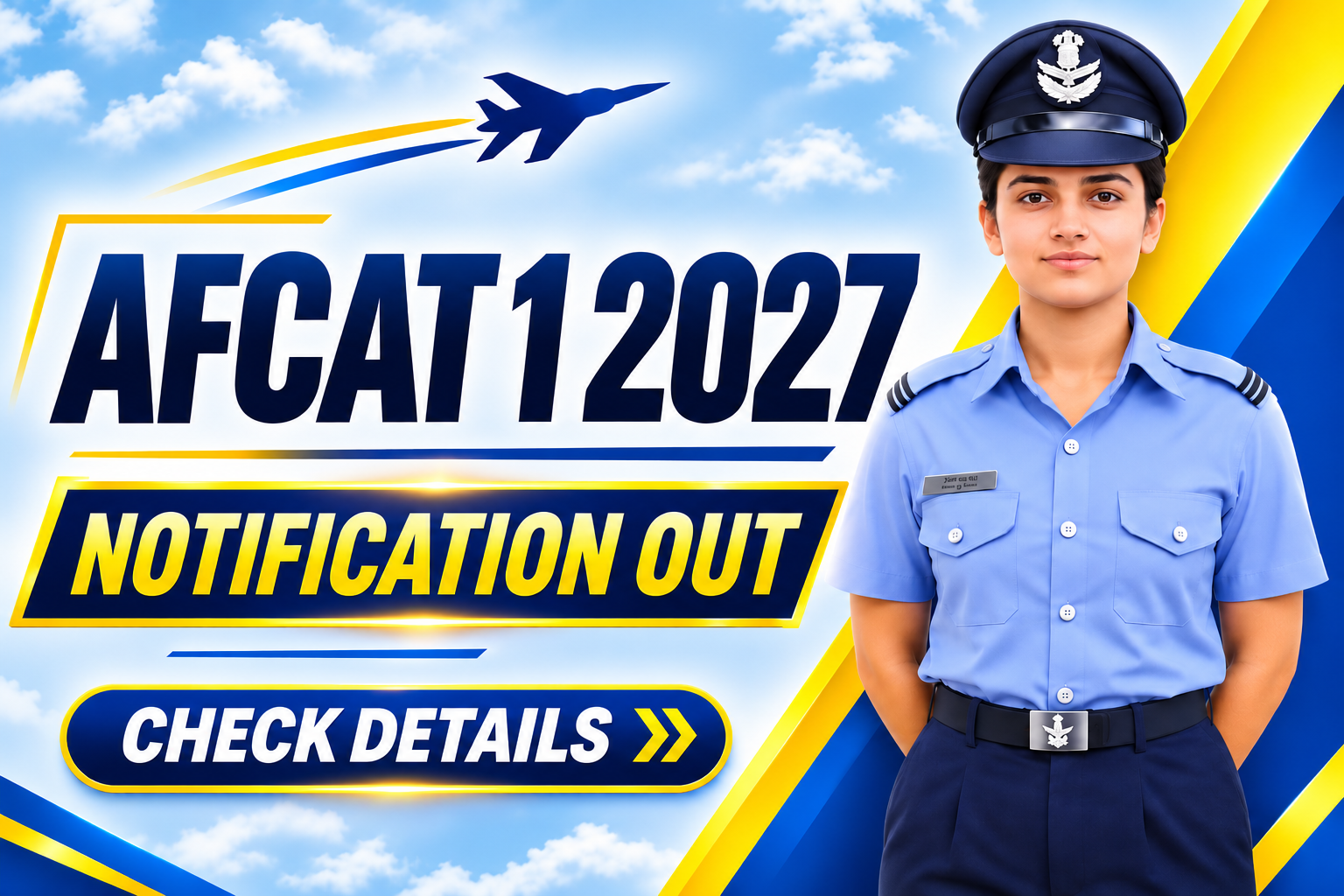
The AFCAT 01/2027 notification has been released, with the online registration process scheduled to start on 12 November 2026. Candidates preparing for this examination should familiarise themselves with the notification, application schedule, eligibility requirements, examination pattern, syllabus and complete selection procedure.
AFCAT-1 2027 Official Notification
AFCAT 1 2027 – Important Dates and Examination Overview
The Indian Air Force organises the AFCAT examination twice every year, commonly known as AFCAT 1 and AFCAT 2. The AFCAT 01/2027 recruitment is being conducted for courses scheduled to commence in January 2028.
The important examination details are provided below:
| Particulars | Details |
|---|---|
| Examination Name | AFCAT 01/2027 |
| Conducting Authority | Indian Air Force |
| Notification Date | 12 November 2026 |
| Application Start Date | 12 November 2026 |
| Last Date to Apply | 11 December 2026 |
| Examination Date | 31 January 2027 |
| Examination Mode | Online |
| Total Questions | 100 |
| Maximum Marks | 300 |
| Examination Duration | 2 Hours |
| Available Branches | Flying and Ground Duty |
| Official Website | afcat.edcil.co.in |
Important: Candidates should refer to the official notification for confirmation of examination dates, eligibility conditions and other recruitment-related instructions.
AFCAT 1 2027 Notification and Online Application Schedule
The Indian Air Force has announced the AFCAT 01/2027 recruitment notification. According to the announced schedule, the online application window will open on 12 November 2026 at 11:00 AM and remain available until 11 December 2026 at 11:30 PM.
The recruitment process includes AFCAT Entry, NCC Special Entry and GATE Score Entry for candidates who fulfil the relevant branch-specific requirements.
Interested applicants should carefully examine the detailed notification before choosing their preferred entry. Providing accurate information and completing the application within the prescribed deadline are essential parts of the registration process.
Candidates can submit their applications through the official AFCAT recruitment portal.
AFCAT 1 2027 Eligibility Criteria
Before registering for AFCAT 2027, aspirants must ensure that they satisfy the age, educational qualification, marital status and medical standards prescribed by the Indian Air Force.
Age Limit
The age requirements for AFCAT 01/2027 are calculated as of 1 January 2028.
- Flying Branch: Candidates should be between 20 and 24 years of age.
- Flying Branch with a valid DGCA Commercial Pilot Licence: The upper age limit is relaxed to 26 years.
- Ground Duty Technical and Non-Technical Branches: Applicants must be between 20 and 26 years of age.
Candidates must also comply with the marital status conditions and other eligibility requirements specified in the official notification.
Educational Qualifications
The minimum educational requirements depend on the branch for which a candidate intends to apply.
- Flying Branch: Applicants should hold a graduation degree with a minimum of 60% marks or possess a BE/BTech qualification with at least 60% marks. Additionally, they must have secured a minimum of 50% marks individually in Physics and Mathematics at the Class 12 level.
- Ground Duty Technical Branch: Candidates must possess a relevant four-year engineering or technology degree with the prescribed percentage of marks. They must also meet the required Class 12 Physics and Mathematics conditions.
- Ground Duty Non-Technical Branch: A graduation degree with the required marks is necessary for Administration and Logistics entries. Other specialisations, including Accounts, Education and Meteorology, have their own specific academic requirements.
Candidates currently pursuing their final year of graduation may also be eligible, provided they satisfy the prescribed academic performance, backlog and degree-completion conditions.
Since educational requirements differ across branches and specialisations, applicants should consult the AFCAT 01/2027 detailed notification before applying.
AFCAT 1 2027 Examination Pattern
Understanding the AFCAT examination pattern is an important part of developing an effective preparation strategy. The written test is conducted online and consists of multiple-choice questions covering four major subjects.
Candidates are required to attempt 100 questions within a total duration of two hours.
The marking scheme and examination structure are as follows:
| Examination Particulars | Details |
|---|---|
| Total Questions | 100 |
| Maximum Marks | 300 |
| Examination Duration | 120 Minutes |
| Correct Answer | +3 Marks |
| Incorrect Answer | -1 Mark |
| Unattempted Question | 0 Marks |
The four main sections included in the AFCAT written examination are:
- English
- General Awareness
- Numerical Ability
- Reasoning and Military Aptitude
Aspirants should focus on improving conceptual understanding, accuracy and time management to perform well in the examination.
AFCAT 1 2027 Syllabus – Complete Subject-Wise Details
A thorough understanding of the AFCAT syllabus helps candidates organise their preparation and allocate sufficient time to every subject. Rather than concentrating on selected topics, aspirants should cover the prescribed syllabus systematically.
The major subjects and their important topics are explained below.
1. English
The English section evaluates a candidate’s language proficiency, vocabulary, grammar and comprehension skills.
Important topics include:
- Reading Comprehension
- Synonyms and Antonyms
- Vocabulary
- Error Detection
- Idioms and Phrases
- Sentence Completion
- Cloze Test
- Grammar and Sentence Structure
2. General Awareness
This section examines candidates’ knowledge of national and international developments, historical events and general studies.
Major topics include:
- Indian History
- Geography
- Indian Polity
- Economics
- Sports
- Defence Awareness
- Science and Technology
- Awards and Honours
- Important Days
- National and International Current Affairs
3. Numerical Ability
The Numerical Ability section tests mathematical understanding and the ability to solve numerical problems accurately within a limited time.
Candidates should prepare the following topics:
- Percentage
- Ratio and Proportion
- Average
- Profit and Loss
- Time and Work
- Time, Speed and Distance
- Simple and Compound Interest
- Number System
- Probability
4. Reasoning and Military Aptitude
This section assesses logical thinking, analytical skills, observation and problem-solving abilities.
The important areas include:
- Verbal Reasoning
- Non-Verbal Reasoning
- Analogy
- Classification
- Coding-Decoding
- Number Series
- Spatial Ability
- Pattern Recognition
For better preparation, candidates should first strengthen their fundamentals, practise topic-wise questions and regularly attempt previous-year papers and mock examinations.
AFCAT 1 2027 Selection Process: All Stages Explained
The AFCAT recruitment procedure involves multiple stages designed to identify candidates who possess the knowledge, aptitude and personality required to become officers in the Indian Air Force.
Clearing the written examination alone does not confirm final selection. Candidates must qualify through the subsequent assessment stages.
Stage 1 – AFCAT Written Examination
The first stage is the online AFCAT examination, consisting of 100 objective-type questions for a maximum of 300 marks.
Candidates who obtain the required qualifying marks are shortlisted for the next stage, which is conducted by the Air Force Selection Board.
Stage 2 – Air Force Selection Board (AFSB) Interview
The AFSB interview is an important stage of the selection procedure. It evaluates whether candidates possess the Officer Like Qualities (OLQs) and personal attributes required for a career in the Indian Air Force.
The assessment process is divided into two major stages.
Stage 1 – Initial Screening
The screening process generally includes:
- Officer Intelligence Rating (OIR) Test: Evaluates reasoning, intelligence and problem-solving abilities.
- Picture Perception and Discussion Test (PP&DT): Candidates observe a picture, develop a story and participate in a group discussion.
Candidates who successfully clear the screening assessment are eligible to participate in Stage 2.
Stage 2 – Comprehensive Personality Assessment
Candidates who qualify for screening undergo several assessments to evaluate their personality, leadership potential and suitability for military service.
The major components include:
1. Psychological Tests
These tests are conducted to understand candidates’ thought processes, behavioural patterns and personality characteristics.
The assessments include:
- Thematic Apperception Test (TAT)
- Word Association Test (WAT)
- Situation Reaction Test (SRT)
- Self Description Test (SDT)
2. Group Testing Officer (GTO) Tasks
GTO activities evaluate leadership, cooperation, communication, decision-making and teamwork.
Some important activities include:
- Group Discussion
- Group Planning Exercise
- Progressive Group Task
- Individual Obstacles
- Command Task
- Other outdoor group activities
3. Personal Interview
During the personal interview, candidates interact with an interviewing officer who evaluates their confidence, communication skills, awareness and personal background.
Questions may cover educational qualifications, family background, hobbies, achievements, life experiences, interests and current affairs.
Together, these assessments help the selection board evaluate the overall personality and officer potential of each candidate.
Stage 3 – Computerised Pilot Selection System (CPSS)
Candidates applying for the Flying Branch who are recommended by the AFSB must undergo the Computerised Pilot Selection System (CPSS), wherever applicable.
This assessment evaluates a candidate’s aptitude and suitability for pilot training in the Indian Air Force.
It is important to remember that CPSS is a once-in-a-lifetime assessment. Candidates who have previously appeared for and failed this test are not permitted to take it again.
Stage 4 – Medical Examination
Candidates recommended by the AFSB must undergo a comprehensive medical examination at the designated Air Force medical establishment.
The medical assessment determines whether applicants satisfy the prescribed physical and medical fitness standards for their selected branch.
Different branches may have different medical requirements, so candidates should understand the relevant standards before proceeding with the recruitment process.
Stage 5 – Final Merit List
The final merit list is prepared by considering candidates’ performance in the written examination and AFSB assessment, subject to medical fitness and the availability of vacancies.
Candidates who secure a position in the final merit list receive joining instructions for the prescribed training programme.
AFCAT Coaching in India – Prepare with Doon Defence Academy
Preparing for AFCAT requires more than simply studying the prescribed subjects. Aspirants must develop a balanced approach that combines academic preparation, examination practice, personality development and an understanding of the AFSB selection procedure.
Doon Defence Academy offers defence examination preparation programmes for students aspiring to join the Indian Armed Forces through various competitive entries, including NDA, CDS, AFCAT and other defence recruitment examinations.
The academy focuses on providing structured learning opportunities through classroom preparation and digital learning support.
AFCAT aspirants should concentrate on the following important preparation areas:
- Concept-Based Learning: Develop a clear understanding of English, Mathematics, General Awareness and Reasoning through systematic study.
- Regular Mock Tests: Attempt practice examinations to evaluate your preparation, improve accuracy and develop better time-management skills.
- Current Affairs Preparation: Follow important national, international and defence-related developments to strengthen your General Awareness.
- AFSB Interview Preparation: Gain familiarity with OIR, PP&DT, psychological assessments, GTO activities and personal interviews.
- Personality Development: Improve communication, confidence, self-awareness, leadership abilities and participation in group activities.
Doon Defence Academy also provides a structured 14-Day SSB Preparation Programme at its Lucknow and Dehradun centres for candidates seeking focused preparation before their selection board assessment.
With experienced mentors, organised classroom sessions and consistent practice, aspirants can work towards improving their performance across the different stages of defence selection.
Conclusion
AFCAT 1 2027 is an important opportunity for graduates who wish to become commissioned officers in the Indian Air Force. Whether you are targeting the Flying Branch or Ground Duty positions, a well-planned preparation strategy can make a significant difference to your performance.
Success in AFCAT requires a combination of subject knowledge, regular examination practice, personality development and thorough preparation for the AFSB interview.
Candidates should begin their preparation early, follow the official syllabus, solve previous-year question papers and remain updated with recruitment announcements.
For aspirants looking for professional guidance, Doon Defence Academy offers defence examination preparation and SSB training programmes to help candidates prepare for their defence career aspirations.
Stay focused, maintain consistency and work towards your goal of wearing the Indian Air Force uniform. Your journey towards becoming an Air Force officer begins with the right preparation.